by Richard Taylor : 2024-11-04
A few people have mentioned recently that they read my article on NISS which I wrote about 5 years ago.
Since then I have experienced a few practical issues with NISS which I thought I should point out, but have never got round to until now. In particular I tripped up initially with pseudoblocks when I tried them with NISS; and also how to write out my partial solution when doing insertions into a NISS skeleton.
Before I get into the main part of the article I wanted to mention something about scrambling for NISS. It may seem easier to write down the inverse scramble underneath the normal scramble to save you the effort of working it out every time - but inverting a set of moves on the fly is a very useful skill.
Consider this partial solution:
(D2 B' R)      // EO
(F D B' L2)    // 2x2x2
D2 B' D' B F2  // 3x2x2
D' F D F' D'   // AB5C3E
We have solved EO and a 2x2x2 on the inverse and then switched to normal for a 3x2x2 block and solving some corners and edges (all but 5 corners and 3 edges). How do you re-scramble to proceed on the normal or switch back to the inverse?
To proceed with the normal (if the scramble is N) then you need the inverse of the inverse parts, from bottom to top, then the normal scramble, then the normal parts from top to bottom:
L2 B D' F'  R' B D2  N  D2 B' D' B F2  D' F D F' D'

^           ^           ^              ^
2x2x2       EO          3x2x2          AB5C5E
So there you need to invert the inverse parts on the fly. In contrast, to switch back to the inverse scramble (N') then you need the inverse of the normal parts, from bottom to top, then the inverse scramble, then the inverse parts from top to bottom:
D F D' F' D  F2 B' D B D2  N'  D2 B' R  F D B' L2

^            ^                 ^        ^
AB5C3E       3x2x2             EO       2x2x2
And here you need to invert the normal parts on the fly. So either way you need to be able to invert things on the fly (accurately) and getting good at it is very useful. With a little practice it soon becomes automatic :-)
BTW the same rules apply if the normal and inverse parts are intermixed in a different way - you always apply the inverse of one direction going from bottom to top, then the "scramble part", then the opposite direction as-is going from top to bottom.
Firstly let's remind ourselves how pseudoblocks work with normal scrambles. For this whole section we'll use this scramble and call it N.
R' U' F U2 L2 F2 L2 B2 D' R2 D' L2
F2 L2 B' U2 L R F R B D R2 F R' U' F
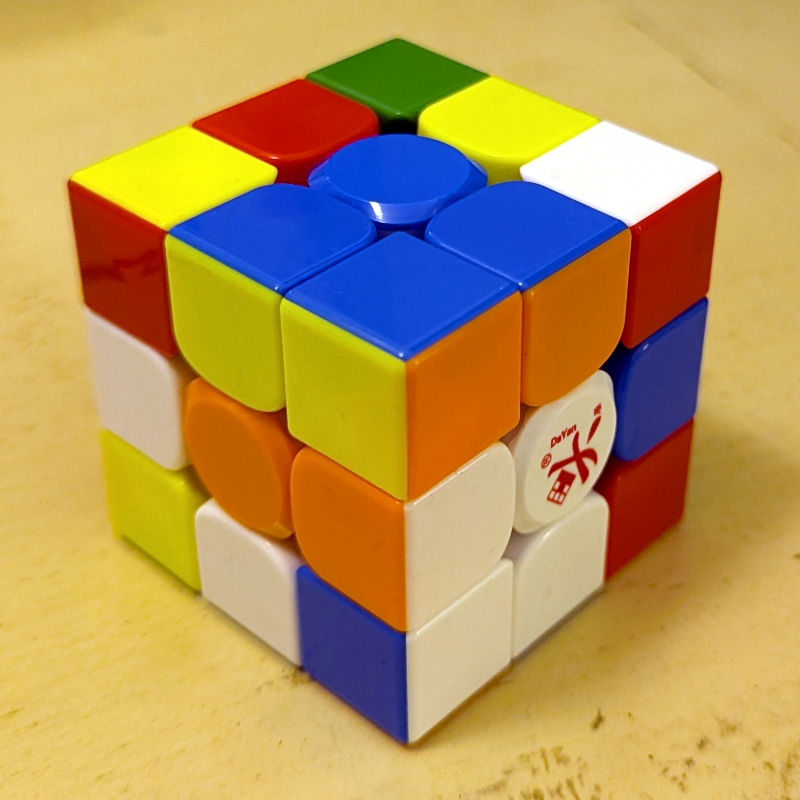
If we do B' U2 R D L2 B' then we nearly get a
2x2x2 block, like this. We could solve the whole cube from here with the
blue face out by one turn and then do a B move at
the end.
But the "magic" of pseudoblocks is that we can just do the B move before the scramble (as a "premove") then we get a real 2x2x2 block.
Try this sequence to test it:
B N B' U2 R D L2 B'
Notice how doing a "premove" of B before the scramble is exactly the same as switching to the inverse after the block and adding a (B') part. So using NISS notation we could write our initial solution as:
B' U2 R D L2 B'  // p 2x2x2
(B')             // premove B
where the "p" indicates a pseudoblock.
What if we do a pseudoblock on the inverse?
(B' D B2 R' D F') // p 2x2x2 premove U'
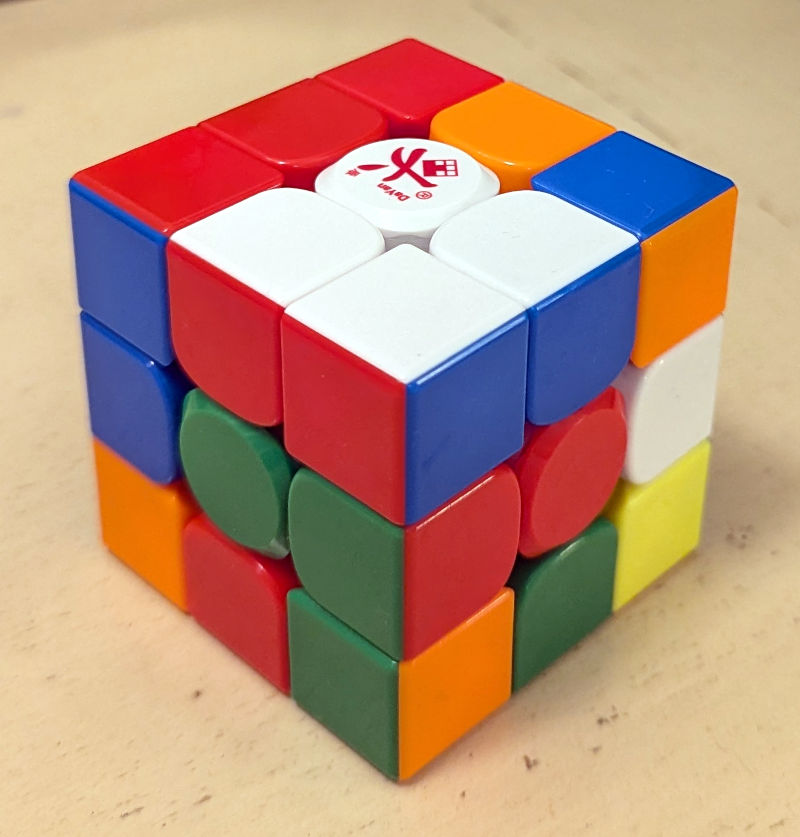
This time we need the equivalent of switching back to the normal scramble after the block and adding a U part. So using NISS notation we could write this partial solution as:
(B' D B2 R' D F')  // p 2x2x2
U                  // premove U'
This is the "secret" of how to do pseudoblocks with NISS. Whenever you make a pseudoblock on a particular direction, you add the inverse of the premove onto the other direction, as if you had done a switch straight after making the block.
Let's check this by making a pseudoblock on the inverse and following it with another pseudoblock on the normal scramble...
(B' D B2 R' D F')  // p 2x2x2
U                  // premove U'
B2 L2 D B' L B2    // p 3x2x2
(B')               // premove B
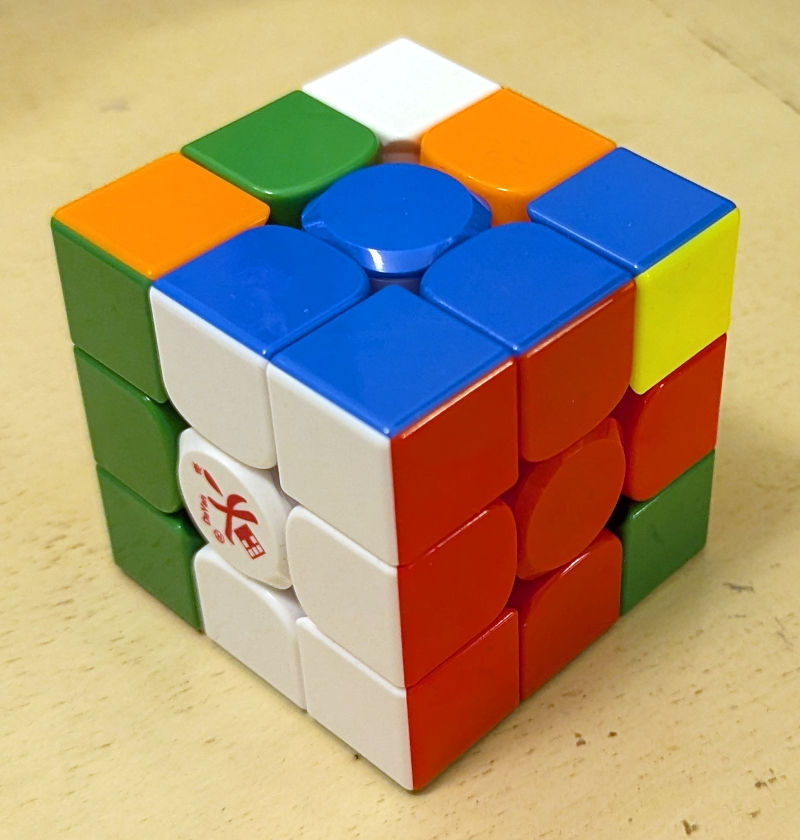
See how we have inverse and normal parts both with "premoves" mixed in. Check that this gives a full 3x2x2 block:
B  F D' R B2 D' B  N  U  B2 L2 D B' L B2

^  ^                  ^  ^
p  2x2x2              p  3x2x2
So there you have it. To mix pseudoblocks with your NISS parts you just have to apply the inverse of the premove as a switch to the opposite direction immediately after making the pseudoblock.
This makes sure that if you have multiple "premoves" that they all end up in the right place.
I don't remember why I had trouble with this, because it is quite simple really. Anyway, if you have a NISS skeleton like this:
(D2 B' R)       // EO
(F D B' L2)     // 2x2x2
D2 B' D' B F2   // 3x2x2
(D' F D F' D')  // AB5C3E
(F D' F' D)     // AB3C3E
Then what I do is write out the solution as if I was extending the normal scramble, with a big clear symbol, like Ⓢ, where the scramble goes:
D'  F   D   F'  D   F   D'  F'  D   L2  B

D'  F'  R'  B   D2  Ⓢ   D2  B'  D'  B   F2
Starting with a solved cube, I go through the moves one at a time, putting a mark under each move as I do it. When I find an insertion point I put a dot between the moves before and after it, with a number above it showing the number of cancellations.
At the end, when I have a full solution, I just copy the moves before the Ⓢ to the end. That's it.
If you write out your solution later in NISS notation then it looks a bit odd, because any cancellations in the inverse parts look back to front:
solution:  D2 B' D' B F2 D' F D F B2 L2 F2 D F2 L2 B
           U F2 U' B U D F D' F' D L2 B D' F' R' B D2

(D2 B' R)       // EO
(F D B' L2)     // 2x2x2
D2 B' D' B F2   // 3x2x2
(D' F D F' D')  // AB5C3E
(* F D' F' D)   // AB3C3E

* F2 ^ U' B' U F2 U' B U  // solve 3 corners +8-1
^ B2 L2 F2 D F2 L2 B2 U   // solve 3 edges   +8-3
But it's better to get the solution right than to try and make the notes look good!
NISS is a very powerful technique for FMC. Some of the other FMC techniques like pseudoblocks and insertions do play nicely with NISS, as long as you are accurate with your note taking.